

Welcome to FullStack HR, and an extra welcome to the 63 people who have signed up since last week.
If you haven’t yet subscribed, join the 11200+ smart, curious HR folks by subscribing here:
Happy Wednesday,
Let’s get straight into it.
I have lost count of how many times I’ve gotten the question: Is AI taking our jobs or not? Last time I got it was yesterday, speaking to a group of executives.
I always answer politely, but I’m also a bit tired of the debate about AI and jobs. Not of AI. Of how we talk about it. It has been stuck in the same loop for three years now, and both sides have started making things up.
One side says no jobs are being lost to AI. That it’s overblown, that Block was just correcting pandemic over-hiring, that the aggregates aren’t moving. Calm down.
The other side says all jobs are being lost to AI. That 300 million will disappear, that Gen Z is doomed, that anyone who doesn’t learn to prompt is out in eighteen months. Calm down.
Both have half the truth and pretend to have all of it. We need to stop picking sides and start holding two thoughts in our heads at the same time (which is surprisingly hard for people).
Jobs are being lost to AI.
Earlier this month, the CEO of Coinbase, Brian Armstrong, laid off 14 percent of Coinbase. He talked about rebuilding the company as an intelligence, with humans at the edges aiming it.
In his view, this is an entirely new view of what a company is. AI in the middle, people at the edges. Not engineers, designers and product managers running the work, but player-coaches and one-person teams aiming agents. If even half the tech CEOs are starting to think like this about their companies, it’s the biggest reshaping of knowledge work since the office was invented.
And Coinbase isn’t alone. Block laid off 4,000 people in March and Jack Dorsey said straight out it was AI. As the reason. Block had built an internal AI tool called Goose that had been running for over a year, and they reorganised around AI before the layoffs. Pinterest, CrowdStrike, Chegg, Snap, Shopify have all done the same.
But the layoffs aren’t the most important evidence; it’s what the technology can do.
MIT’s Crashing Waves vs. Rising Tides study from April, based on over 17,000 evaluations of AI models across more than 3,000 work tasks from the US Department of Labor, concluded that AI isn’t arriving as sudden waves over narrow areas but as a rising tide across nearly all text-based tasks at the same time. Models went from 50 percent success on hour-long tasks in 2024 to 65 percent in 2025, and the projection is 80-95 percent on most text-based tasks by 2029.
METR measures the same thing from another angle. The length of tasks an AI can complete autonomously has been doubling every seven months for six years.
And OpenAI’s own GDPval benchmark shows that frontier models are approaching industry experts with 14 years of experience in quality of delivery, measured across 44 occupations.
Anyone claiming nothing is happening hasn’t looked properly. To some extent, AI is taking jobs, whether we like it or not.
Jobs are not being lost to AI.
At the same time, one can argue that job losses are highly overstated.
Oracle is cutting 18 percent while the stock is down 25 percent on the year. IBM paused hiring with AI as the stated reason and then quietly rehired when it didn’t pan out. Sam Altman has warned that some companies AI-wash layoffs they would have made anyway.
And one interesting detail is that none of the major companies that announced AI-driven layoffs, not Block, Coinbase, Pinterest or Shopify, presented any concrete AI productivity metrics on their earnings calls before the cuts.
So they are telling the world that AI is doing so much work that they can let thousands of people go. But for their investors, there are no numbers. No reported increase in output per engineer. No measurable productivity gain to justify 4,000 or 700 redundancies. Just the story.
AI has become the most PR-friendly explanation available. Better than we over-hired during the pandemic. Politically safer than interest rates got us. And Wall Street rewards them for it.
So what?
I think both of these can be true at the same time.
It is possible that AI is driving real layoffs in specific roles and age groups, at the same time as many AI-attributed layoffs are financial decisions dressed up in transformation language. Both are true in the same quarterly report.
That’s why the debate runs into the ditch. One side points at Block and Coinbase. The other points at IBM and Oracle. Both are right. And both pretend the other side’s bucket of evidence doesn’t exist.
There’s also the burnout paradox.
Yesterday, Glassdoor released a report on burnout in the US labor market. Mentions of burnout in Glassdoor reviews are up 65 percent year-over-year in the first quarter of 2026, and 2.5 times higher than the pre-pandemic benchmark. The sharpest increase ever recorded came last year.
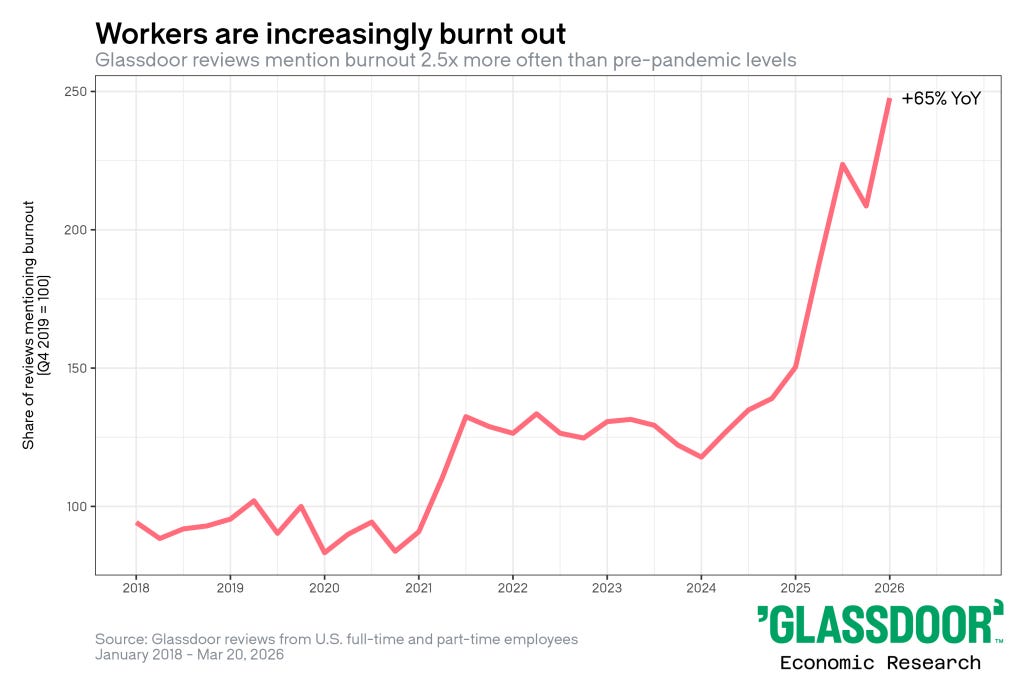
If AI is already taking over as much work as the big narrative claims, shouldn’t burnout be going down? Less to do, less stress, more breathing room in the schedule?
The opposite is happening. Burnout is rising faster than ever. And there are two readings of why.
Either AI isn’t taking over much work yet, and people are working as hard as ever or harder in a nervous economy, or in which case the panic narrative is overblown.
AI is taking over some work, but organizations are using the gain to demand more of people instead of easing the pressure. In which case the optimist narrative about AI as liberation is a fairy tale.
Neither reading is that great. And they don’t contradict each other; I believe both are somewhat true, but it isn’t the post-work utopia AI companies write about in their white papers. It isn’t the job apocalypse economists warn about either. It’s something else. A quieter, more exhausting version of both.
But in the long run I lean one way
Last month I sat with a marketing director who was about to break down. Her team had never been able to afford video. They were too few. Then they tried producing with AI and suddenly three people were making twenty videos a month. She thought at first she’d have to let someone go. Two months later she hired one more.
We talk about AI and jobs as if the pie is fixed. As if there’s a set amount of work in the world, and if AI does some of it, there’s less left for people.
That isn’t true historically. And I don’t think it’s true now.
When one person can suddenly do what used to take five, what we always talk about happens. Some roles disappear. Uncomfortable but true. But the other thing happens too. Ambition changes. When an organisation discovers that ten people can deliver what used to take fifty, they don’t stop at ten. They raise the bar. They launch more products. They say yes to customers they used to turn down.
And suddenly they need twenty again. Just that the twenty do ten times more.
This isn’t just historical anecdote, RAND published an analysis of US census data in October. The conclusion was that while some firms have decreased employment through AI replacing tasks, a larger share has reported increases in employment connected to AI adoption.
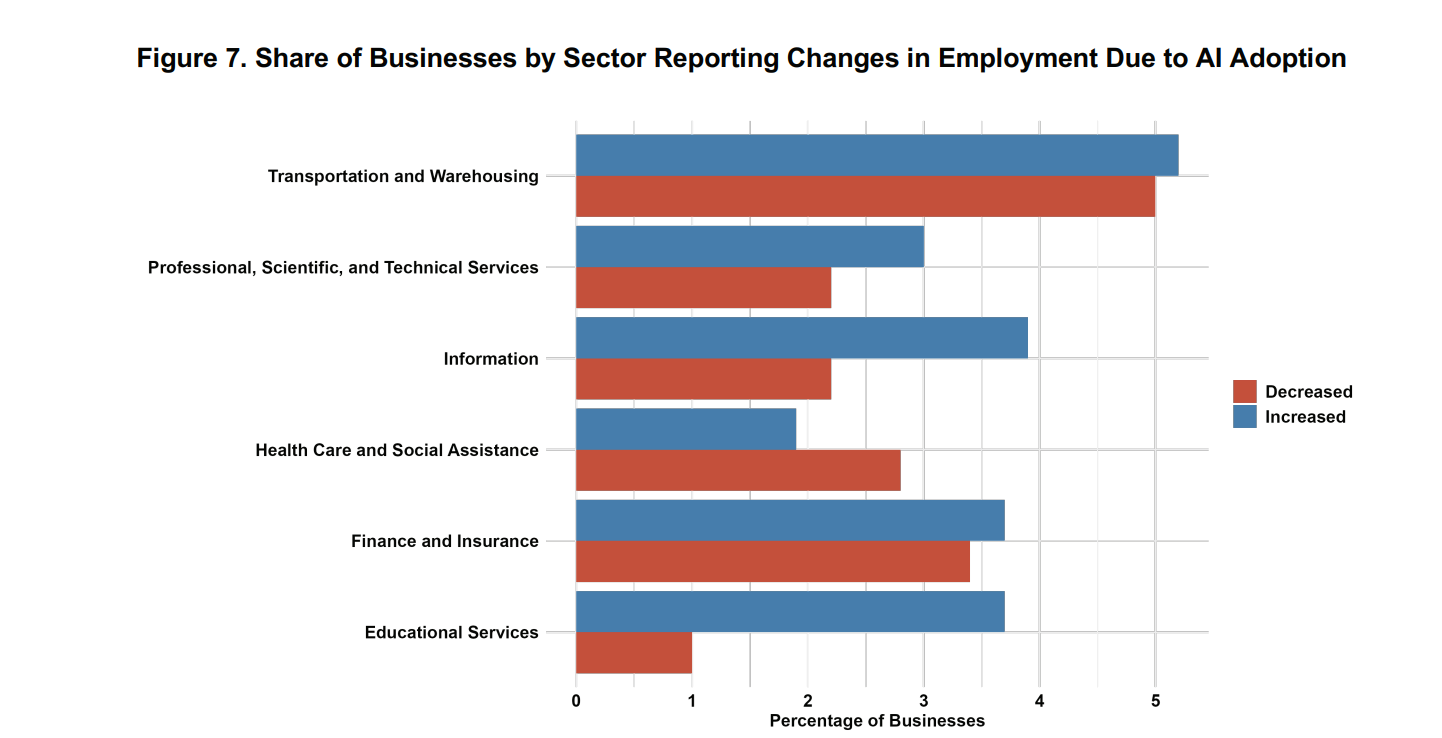
The gap between what the technology can do and what organisations actually do is where people remain.
And Welburn and Nygaard, the RAND economists, close with exactly what I’m trying to say. Jobs are more than individual tasks. They are a string of tasks assembled in a specific way. Crude calculations of labor market exposure to AI have failed to capture what jobs actually are.
If MIT authors Mertens and Thompson are right about the tide, then the pace of task automation could outpace the pace of ambition expansion. In that case, it isn’t the even redistribution I’m describing, but a systematic displacement where people lose ground faster than organizations scale up their ambition.
But don’t say it will sort itself out
And that’s one of the points to strongly consider for the organizations.
AI is undoubtedly disrupting work, maybe not in terms of destruction but in terms of change. Will we have enough time to reskill or upskill people to do those jobs?
It’s easy here to point to the Industrial Revolution. “We fixed this in the past; there will be more jobs in the long run. Look at the Industrial Revolution”.
Yes, that is true. But it took a while.
I spent all of last Christmas essentially reading up on this. E.P. Thompson, Robert Allen, Joel Mokyr, and Sven Beckert on cotton. Lectures on the Prussian army and German industrialization.
Why does an AI consultant read history books on the Prussian army? Because I didn’t trust the simple story, and I wanted to understand more. My whole work depends on leadership teams making better decisions about what’s happening right now, I needed to understand what happened the last time people said technology would take the jobs. Not what we say happened in hindsight. Those are two different things.
And it wasn’t all sunshine and roses.
It’s true that it evened out into prosperity, eventually. The country boys from the late 1700s first became factory workers in Manchester and Birmingham. Their grandchildren moved into offices in the early 1900s, but not on their own. The school system in its modern form was designed precisely to supply the factory, and later the office, with workers. Disciplined, literate, time-regulated bodies. It took roughly a hundred years to rebuild the education system to industry’s needs. Real wages only began rising in earnest after 1840, seventy years after the first factory opened its doors, according to Robert Allen’s research at Oxford. The middle class emerged, and society as we know it was rebuilt.
But it took 150 years.
And the journey there wasn’t all smooth sailing for people in general. Falling or stagnant real wages for decades. Luddite uprisings for which people were executed. Manchester and Liverpool were the shock cities of the revolution. Child labour in factories that didn’t exist before. Several generations born, living and dying during the transition itself, without ever seeing it pay out.
Thompson wrote an entire book about the handloom weavers crushed by the factory system. A hundred years after they were already gone, he wanted to rescue their memory from what he called the enormous condescension of posterity. What we do, in hindsight, to those who didn’t keep up, when we tell the story as if it was obvious they would lose.
We look back from the balcony of prosperity and tell the journey as if it was calm. It wasn’t. The winners wrote the history, the losers never got to hold the pen.
And once again, the Industrial Revolution took around 150 years to be “fully implemented,” if one might call it that. It’s been less than four years since ChatGPT was publicly released. If this transition runs over 15 years, or 5, do we have time to rebuild education, tax systems, social safety nets, identity, and meaning around work? The Industrial Revolution had the time. We don’t know whether we do.
Invoking the Industrial Revolution as comfort is asking to repeat it. The whole package, not just the prosperity bit. And perhaps without the time that allowed the losers’ grandchildren to eventually benefit.
As Oxford economist Carl Benedikt Frey has put it, most economists will acknowledge that technological progress can cause some adjustment problems in the short run. What is rarely noted is that the short run can be a lifetime.
So what do we do?
Both are true. AI takes jobs. AI creates jobs. And at the same time, very little has happened to the aggregate employment numbers in the three and a half years since ChatGPT launched publicly. Anthropic’s own research from this spring finds no systematic increase in unemployment among highly exposed workers since late 2022, but suggestive evidence that hiring of younger workers has slowed in exposed occupations.
Total collapse hasn’t happened. And at the same time, people are burning out faster than ever.
Companies have started the transition. I wrote in March that some of them are probably doing it by laying people off before AI can fully take over that job. Necessity is the mother of invention. You let people go, then the rest of the organisation is forced to solve it with AI. Economists have started calling it low hire, low fire. Companies freeze new hiring rather than running large-scale layoffs.
It’s never binary when people lose their jobs. Interest rates, markets, pandemics, the wrong product strategy, the wrong timing, AI. It all gets woven together. Ignoring AI as a factor is sticking your head in the sand. Saying it’s only AI is underestimating how labor markets actually work.
That’s why is AI taking the jobs or not is the wrong question. It will never get a clean answer. And the question is passive on top of that, as if we are standing on the sidelines watching the technology roll by.
The right question is what do we want AI to do with working life.
Because that’s a choice. Not an inevitable force of nature.
Do we want more people to work with higher output, so we as a society produce more? Do we want fewer people working, but over longer working lives? Do we want to work fewer days per week, or fewer hours per day? Do we want to use the productivity gains for lower prices, higher wages, or more people in meaningful work? Do we want them to go to shareholders, to workers, or to society?
These aren’t technical questions. They are political and organisational. And right now they are being answered by others, who don’t always have the broader interests in mind.
My point isn’t that I have the answers. My point is that we need to start asking the right type of questions. Holding two thoughts in our heads at the same time. AI takes jobs. AI creates jobs. Both are true. Anyone who can’t hold both will make bad decisions, no matter which side they stand on.
And maybe, if we do the work, our grandchildren will be spared from reading books about us with the next Thompson’s enormous condescension in their eyes.
Superbra, du sätter ord på sådan jag tänkt men inte lyckats greppa. Tack för detta!
Great, insightful piece!