

Welcome to FullStack HR, and an extra welcome to the people who have signed up since last week.
If you haven’t yet subscribed, join the 11500+ smart, curious HR folks by subscribing here:
Happy Thursday,
Let’s dive right into it this time.
Jason Averbook’s piece on judgment and AI got me thinking! I highly recommend reading it before reading this piece (and also make sure you subscribe to his substack).
His concern is that we remove the opportunities to practice, then expect people to exercise the judgment those opportunities used to develop. Someone still has to take responsibility when the AI gets something wrong.
I agree with that concern. Our exchange in the comments left me wanting to explore something further, though. As the work changes, how does judgment itself change?
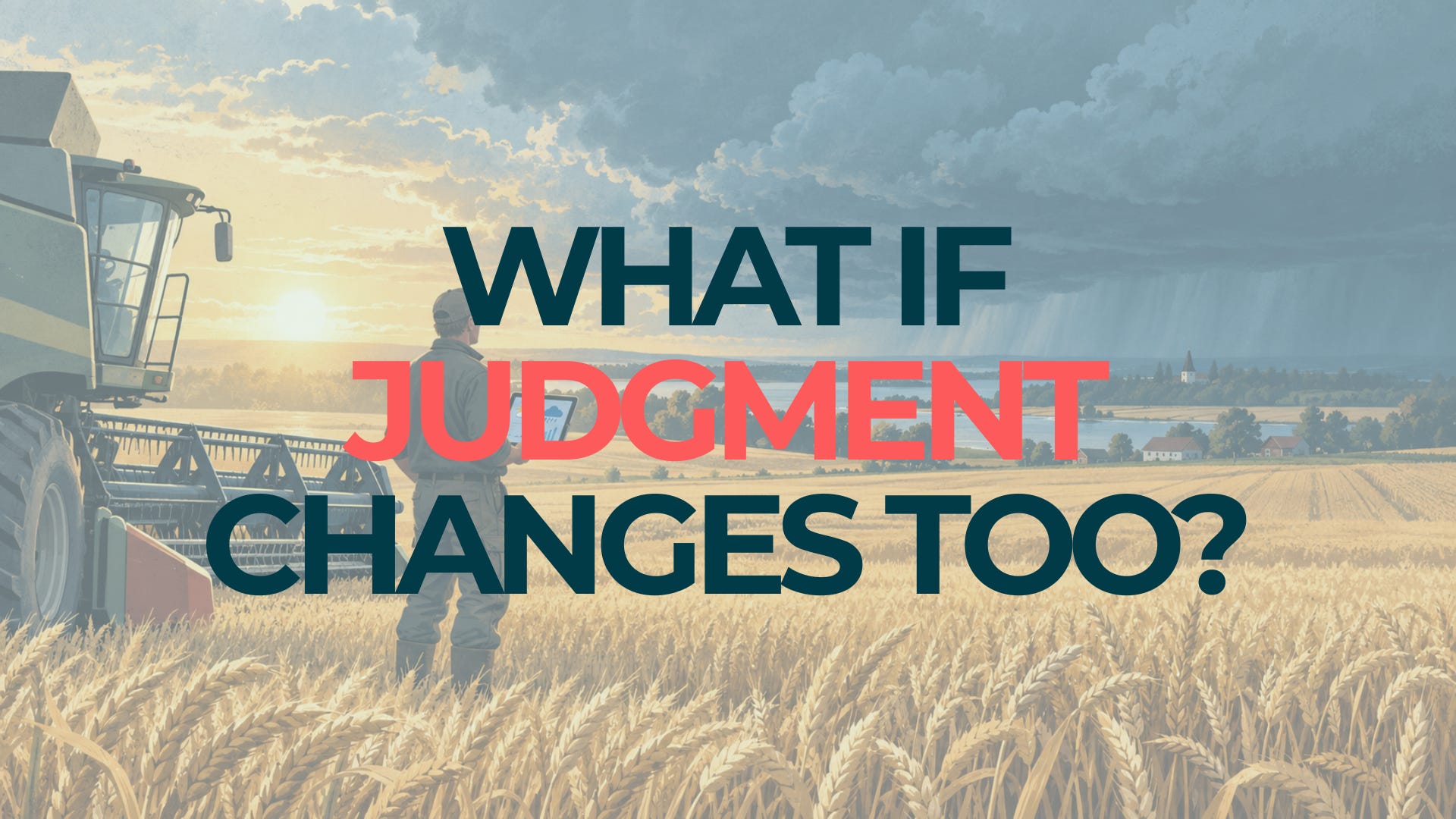
I brought up farming, it’s analogy I’ve been thinking about for quite a while. I live in farm-country in Sweden and of the farmers I know, I wouldn’t call any of them lay, quite the opposite. But imagine dropping a farmer from today into 1926 and saying, “There’s the farm. Get on with it.”
They would recognize the job. They would understand plenty about what needed to happen. But without the equipment, forecasts and other tools they normally use, they would (probably) struggle with parts of it.
I wouldn’t take that as evidence that they were a worse farmer or that they are lazy farmers. They simply learned to farm under different conditions, using different methods. Some of their knowledge would transfer. Some of what they needed in 1926 might be unfamiliar.
Jason’s response was that “the farmer still owns the harvest.” Whatever happens to the tools, the farmer remains responsible for the outcome.
Absolutely. But the methods for taking that responsibility have changed too.
Consider deciding when to harvest. A farmer a century ago might have relied heavily on reading the clouds, noticing the wind and remembering what similar conditions had meant before. Today, a farmer can combine local observations with forecasts and data that earlier generations couldn’t access. The World Meteorological Organization describes how these services support decisions about planting, harvesting and other farm work.
The farmer still has to assess the situation. But using a forecast well requires different knowledge from producing your own prediction by watching the sky.
(And we don’t normally expect the farmer to recreate the weather model before relying on it.)
They need to understand what the forecast means for their decisions, including its uncertainty. They need ways to assess whether it’s useful. Much of the knowledge behind it sits with other people and inside systems they use.
That is already a different way of exercising judgment.
Agriculture has changed alongside a considerable increase in food availability. FAO figures put the global average at around 2,360 calories per person per day in the mid-1960s, rising to more than 3,000 in 2023. Those numbers don’t establish which older skills we can safely lose. But they make it difficult to argue that knowing how to work with fewer tools is, by itself, the measure of a capable farmer.
I think we need to leave room for a similar change in our own professions.
We can remain responsible for a result while using different methods to produce it and assess it. What counts as knowing the craft can (and probably will) change quite substantially along the way.
When we talk about AI and skill erosion, I sometimes struggle to tell which kind of change we’re worried about.
Someone might be losing a capability they still need. They might also be spending less time on something that has become less useful, while developing another capability. And, of course, they might be losing the old skill without learning anything to replace it.
We need to be able to tell those situations apart.
The IBM study Jason discusses surveyed 1,500 HR and workforce leaders and 8,800 employees. It found widespread concern about skill erosion and argues for protecting opportunities to develop human capabilities.
That gives us reasons to investigate. But reported concern doesn’t establish what has happened to someone’s ability to do the work. We would need to examine what they can do, where they struggle and how that changes over time.
The same applies to verification.
If hallucinations become much rarer and AI becomes demonstrably more reliable at a particular task, will we still need the same amount of human checking? Will we check the same things in the same way?
I’m not proposing that we stop verifying today. I’m asking how verification might change as the technology improves.
Being responsible for an outcome doesn’t, on its own, tell us how to check it. The consequences of an error matter. So does the ability of a human reviewer to catch it. We may find better ways to test results, monitor performance or identify the cases that need another opinion.
Some of those methods could involve AI too.
That would change what people need to learn. It could also change how they learn it.
We’ve been working on this with a client through a series of leadership labs. Leaders explored the consequences of different decisions, with AI as a natural part of the decision-making process.
The AI reached its conclusions almost immediately. The leaders had to decide how quickly they were prepared to move with it.
When should you speed up? When should you slow down and spend more time working through the reasoning? What could happen if you acted on that decision?
Those were the questions we practiced with them, and continue to practice.
A quick answer creates an opportunity to move faster. It also puts a choice in front of the person responsible. They need to follow the argument, consider the consequences and decide whether they have enough to act. Sometimes that means keeping up with the AI. Sometimes it means pausing a conclusion that arrived in seconds and spending considerably longer examining it.
I think that ability to change pace deserves more attention in how we develop leaders. Moving slowly through every decision could waste much of what AI makes possible. Moving at the speed of every AI response could leave too little room to understand what we’re about to do.
In these labs, we give leaders practice making that choice while AI is part of the work. They remain responsible for the decision, but they’re learning to take that responsibility under different conditions.
That’s the kind of learning I’d like us to explore more: working through decisions with AI, examining what could follow, and practicing when to move quickly and when to take more time.
For those of us in HR and L&D, that means being precise about what we want people to learn. “Critical thinking” is a pretty broad instruction to hand someone designing a development program.
Pick a task people will be responsible for. Identify the decisions they need to make and the mistakes they need to recognize. Then give them different ways to practice, including with AI, and see whether they can explain their choices and handle an unfamiliar case.
I’d be interested in what happens when we test that. Particularly when the person who does the work well uses a method the rest of us never learned.
The impact of context and conditions is really significant in examples such as the farm analogy you gave, as it is with areas like learning / capability - and very relevant to the judgement question you’re shining a light on.
Thought provoking - thanks!