

Welcome to FullStack HR, and an extra welcome to the 12 people who have signed up since last week.
If you haven’t yet subscribed, join the 11,600+ smart, curious HR folks by subscribing here:
Curious to learn more about Claude Cowork and ChatGPT Work?
I run the third cohort of the popular Cowork for HR starting on the 27th of August.
Three sessions, and the first 10 to sign up get a 30-minute private coaching session with me.
For the last couple of years, as a kind of sanity check, my co-worker Sara and I have been reviewing HR ads.
First, we did it manually. Row by row. (For Sweden only, but still.) Looking for whether anyone happened to drop in at least one mention of AI. No one did in the beginning, and that was maybe not surprising at all- new technology, uncertainty about whether this was hype or something more long-term sustainable.
But last year when we did the Swedish count again, there were still…almost none.
During the summer, I did the Swedish count again. (When I say I, in this case I mean Claude + the excellent open API provided by the national Swedish Public Employment Service)
There were still… almost none.
But what if we widen the lens? Looking beyond Sweden, what happens then?
In how many job ads will AI pop up? I started to count (but again, when I say I, I mean Claude + Monid), and all in all, we’ve analyzed 3,350 job ads in HR.
Before we dive into the data, it’s perhaps good to answer the question of why this matters. Is it at all interesting to look at? Unsurprisingly, my answer to this is yes, for several reasons.
First, I believe this tells us something about the true mindset of organizations right now. My assumption is that if AI is important and/or adopted in an organization, that will be reflected in how they hire. I know this is a somewhat flawed assumption; it could be that AI is important even if it’s not in a job ad or that AI skills are just seen as a commodity in the same way as we expect people to work with email these days.
Yet, I don’t think we’re there.
I think this is one of the best indications to see where we are with the use of AI in HR.
(And yes, I know that putting it in a job ad is easy and that it could be merely words, but I still think it shows some kind of ambition.)
Secondly, research on “learning-by-hiring” shows that recruiting people with relevant expertise can be an important way to introduce and spread knowledge1 within an organization, particularly when new hires collaborate closely with existing employees. It is not the only route to upskilling, but it can be a key component. So, are organizations making enough use of it?
But the data, then?
As mentioned, I’ve analyzed 3,350 HR job ads across the US and 20 European countries. It’s a seven-day snapshot from late July and early August, so think of it as a signal rather than the complete picture. But what does that signal tell us?
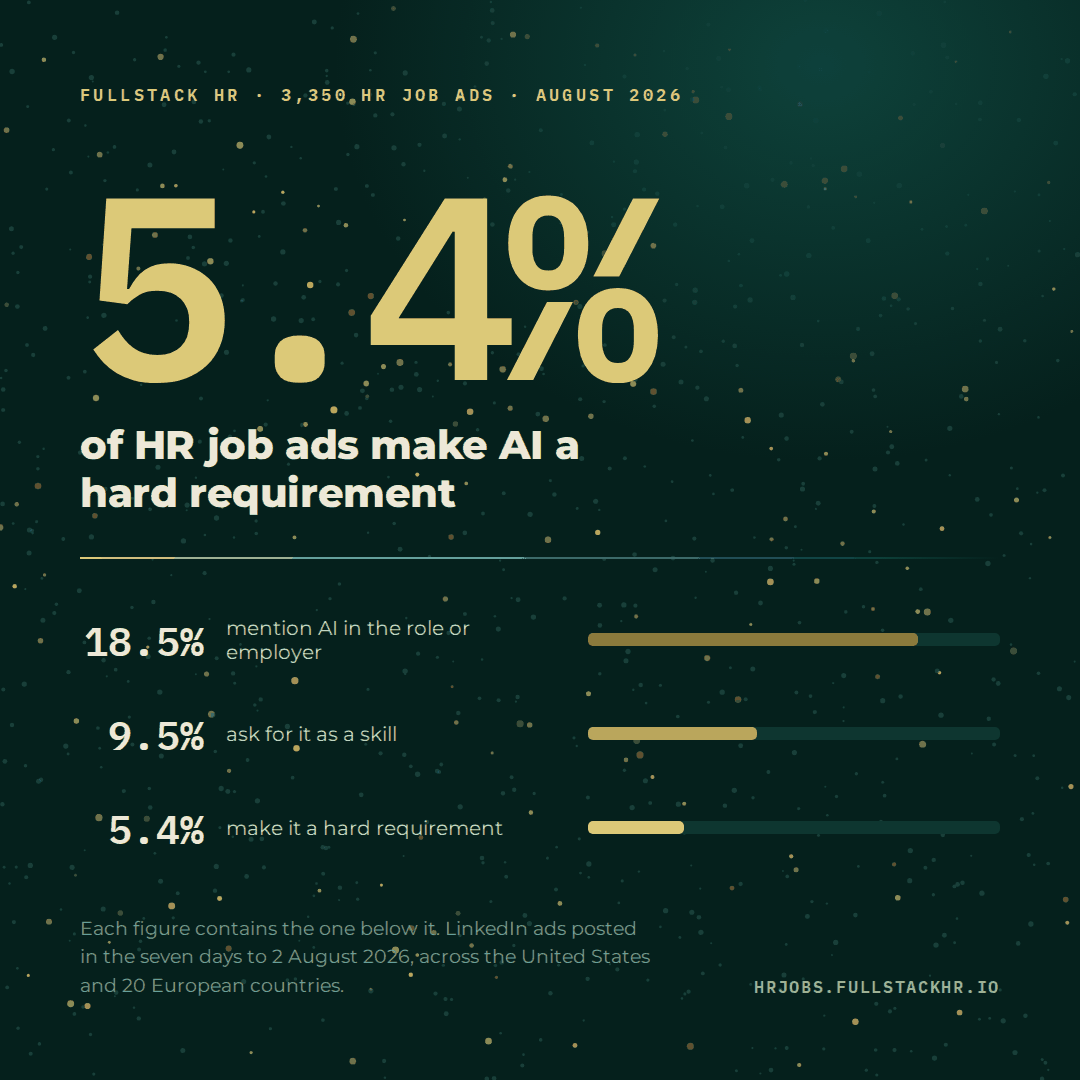
5.4% of them require AI as a hard requirement.
And an additional 4.1% ask for it as a skill that is desired, bringing the total to where an AI skill is asked for to 9.6%.
If we look at the total mention of AI, we see this in 18.5% of all job ads. That could be mentions such as “we work with AI” or that the organization is selling an AI-enabled product.
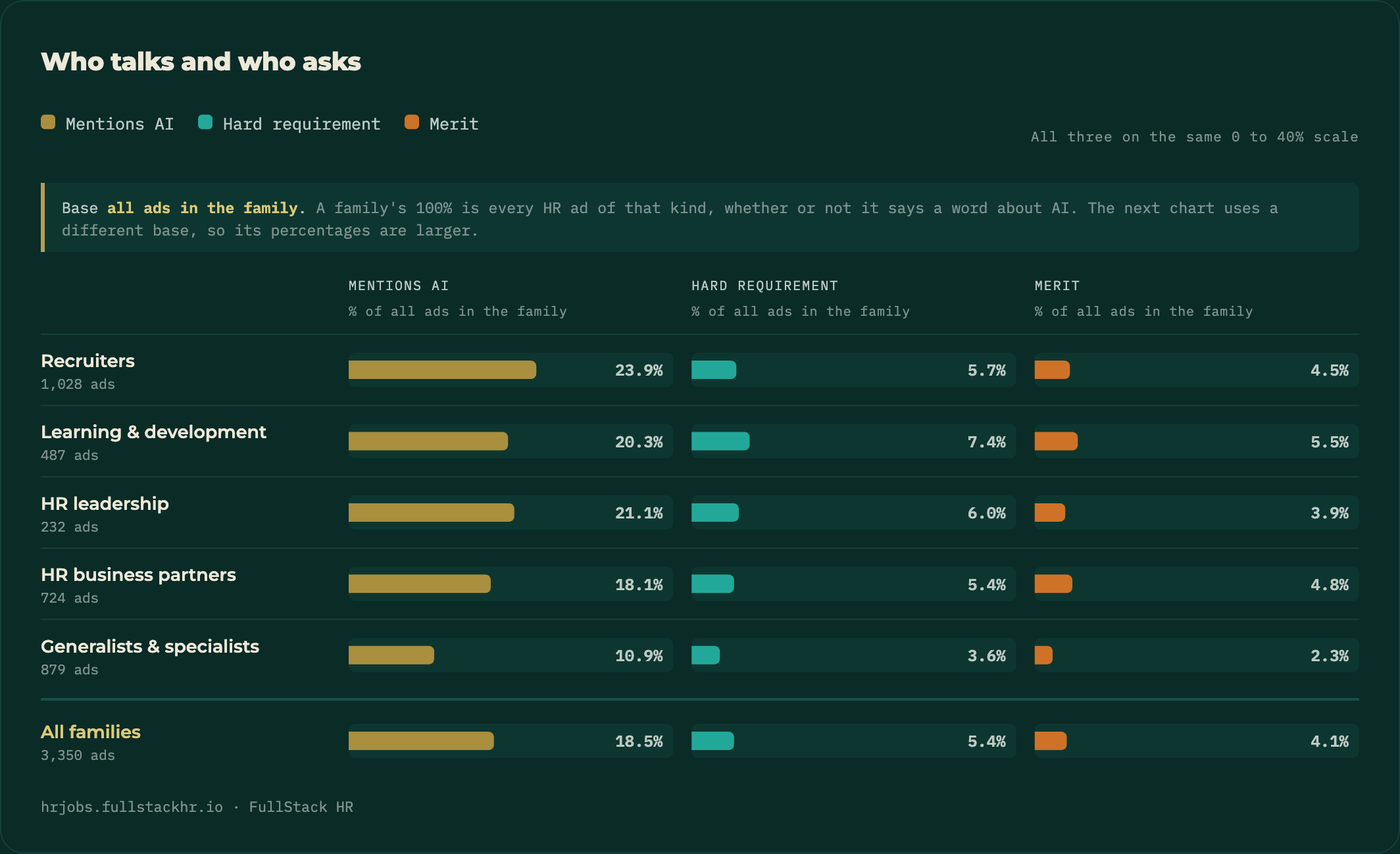
I’ve also analyzed the different roles within HR.
L&D is the leader here. The difference is not vast, but it’s there.
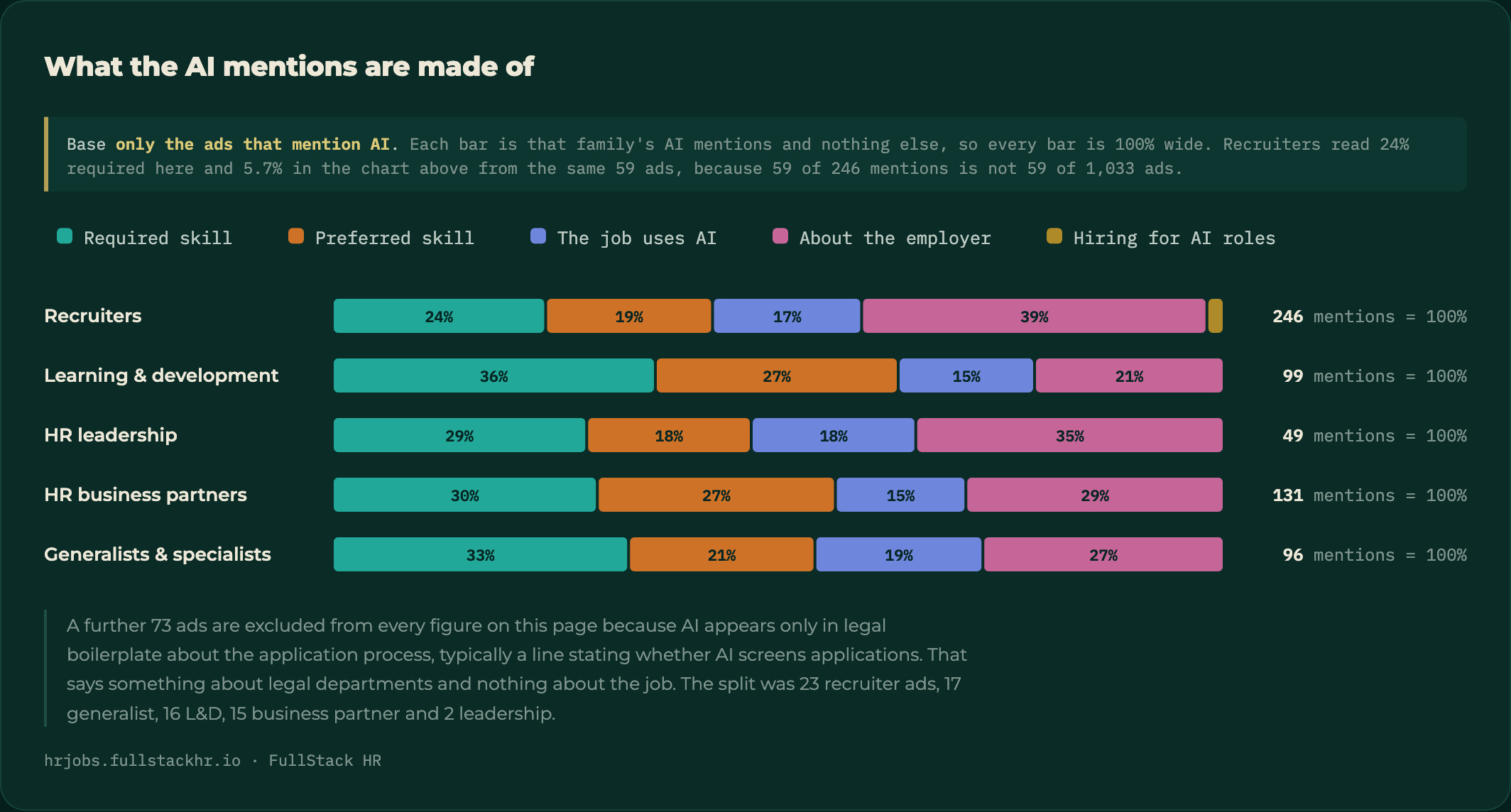
If we widen it to mentions, we see that 18.5% of all job ads mention AI, but if we dig a bit deeper, we see that a lot of these have little to do with the job and are describing the employer. Not ideal but not super bad either; I’ll take that over no mention at least.
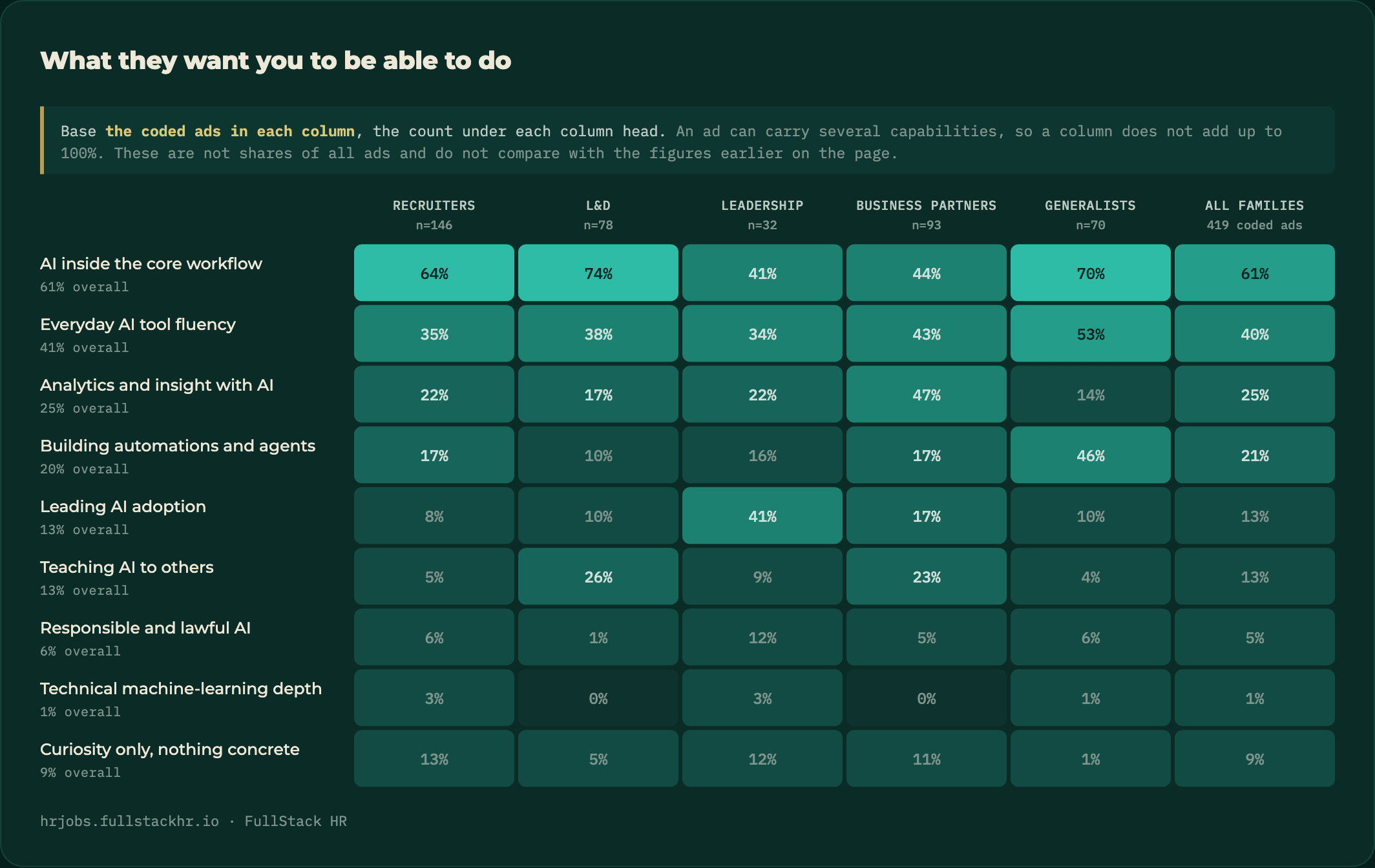
Ok, but those who mention that AI skills are a good thing to have - what kind of skills are they looking for?
You’ll see the results below, but I do want to point out a couple of things.
It’s interesting that HR Leadership is so low in analytics and insights with AI. Why? Isn’t this a core feature for HR Leadership, or are we putting the HRBP:s to the test here?
Same goes for responsible and lawful AI; my expectation would be that this would be super-high for HR Leadership. (Maybe that was more of a hope?)
HR Generalist? Congrats, you're building agents now!
It’s very clear that we’re looking for people who can build stuff inside the HR core workflow and not machine learning experts.
Tooling then? When AI is asked for, what kind of tools do they prefer you use when working? Claude!
Before I get too excited about seeing Claude on top here, it’s worth noting that this dataset is super small. But still, Claude is on top.
Also a big shout-out to one of my very first sponsors, Metaview, for making it into three job ads!
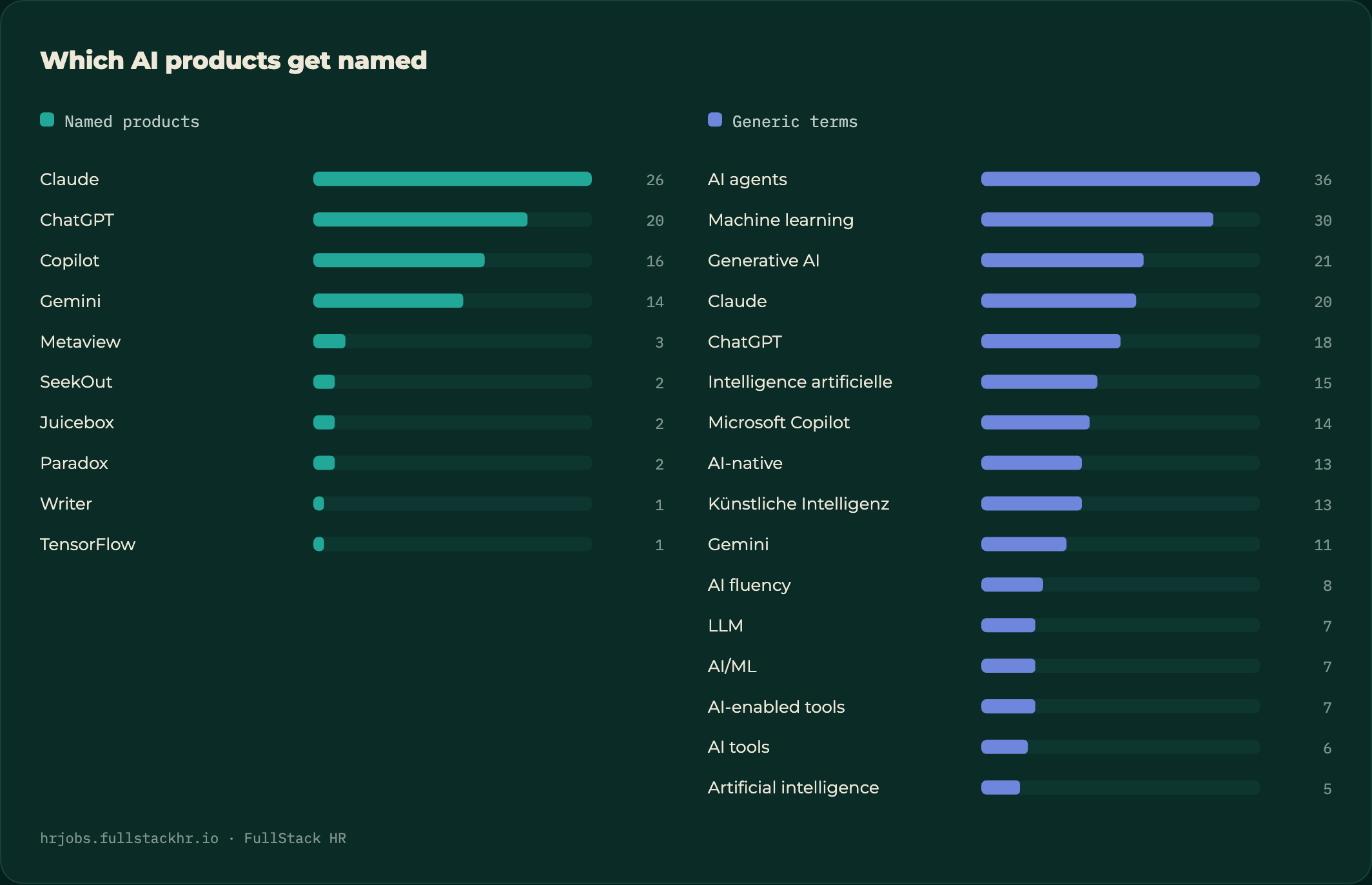
If you want to see the full dataset, head over here. You’ll see whether Europe or the US is in the lead, and what that looks like, country by country.
You can also download the data, upload it into whatever LLM you prefer, and see the methodology and caveats behind this.
What to make out of all of this?
It’s very tempting to scream that this is disastrous and that we need to do better, but that would not be a great analysis. There could and probably is more to this than first meets the eye, and I’ve laid out a couple of these ifs and buts above.
So what is it then? It’s this.
Not hiring people with AI skills won’t be the end of your organization. After all, it’s still a new technology, a new skill. But it’s a missed opportunity.
I understand that vetting such skills is hard if you don’t have them yourself. So maybe don’t make them a requirement, but at least signal in the ad that these are skills you value. That you and your team are curious about.
(After writing the intial article, I got nudge by Martyn Redstone about Sova Assessments AI Readiness - worth checking out to solve this problem!)
Of course, you need to match that job ad with reality. If you want curious AI people on your team, you have to let them be curious AI people once they start.
It could also be that we already treat these skills as something internalized—something we assume people have without needing to vet or make explicit. Think of the email example above. No one asks candidates today whether they can send an email or use the internet. We assume they have those skills.
I would love for that to be the case, but I don’t think that’s what we see here.
My hypothesis is that we still don’t see this as a core competency in HR, and I worry about that. (I’ve written about this several times this summer.)
As a candidate, I would be worried if AI wasn’t mentioned anywhere in the recruitment process. (And preferably not as “we don’t allow it here”.)
The job ad is a great way to signal to candidates and the rest of the organization that this matters to you.
It also helps raise the bar for your current team, new hires, and yourself.
Use it.
Song, J., Almeida, P., & Wu, G. (2003). Learning-by-Hiring: When Is Mobility More Likely to Facilitate Interfirm Knowledge Transfer? Management Science, 49(4), 351–365. DOI: 10.1287/mnsc.49.4.351.14429.