

Welcome to FullStack HR, and an extra welcome to the 12 people who have signed up since last week.
If you haven’t yet subscribed, join the 11500+ smart, curious HR folks by subscribing here:
So they finally arrived, the new models from OpenAI and Anthropic.
In passing I mentioned Fable 5 and how good it was. And it was. For three days we got to test it before it was pulled away from us, but then a week or so ago we got it back. With a promise (threat?) that it was only included until July 7. Included as in you can use it with your regular Claude subscription.
I wasn’t the only one staying up a little too late testing everything possible with Fable 5 before July 7... only to watch Anthropic extend the deadline to July 12.
What happens after that is, at the time of writing, uncertain. Maybe it stops being included in our regular plans and you’ll have to pay per use (I happened to leave a small automation running for a day on a schedule I forgot to change and it cost $40...) or maybe they extend it again.
What speaks for an extension is that OpenAI on Thursday released ChatGPT 5.6 Sol / Terra / Luna.
What’s the difference between them? I think this Reddit post explains it in an extremely pedagogical way.

To add even more complexity, each model also has multiple settings that control the intelligence. Terra and Sol also have an Ultra mode. So three models with a total of 14 (!) different modes.
OpenAI and naming, huh...
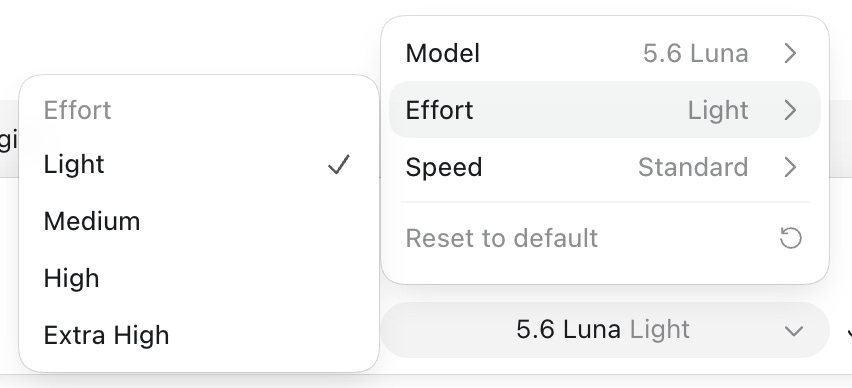
On top of that, they're doing what they previously announced and merging the ChatGPT and Codex apps on desktop. It's pretty obvious they've been glancing hard at Claude Cowork, and in a countermove (?) Anthropic redesigned the Claude app this week and removed (!) the Cowork tab, moving it to the chat page.

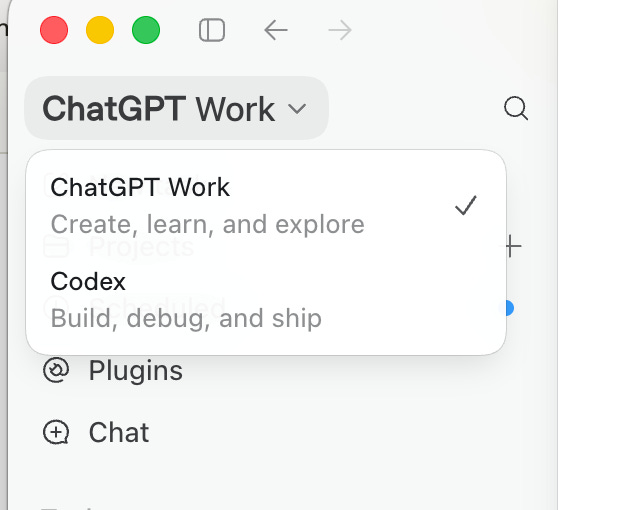
Hard to keep up? It’s not easy for me either, especially not ChatGPT Work compared to what used to be “just” Codex.
And I wasn’t alone in being confused. Even Ethan Mollick was confused but got an answer from Dominik Kundel at OpenAI.
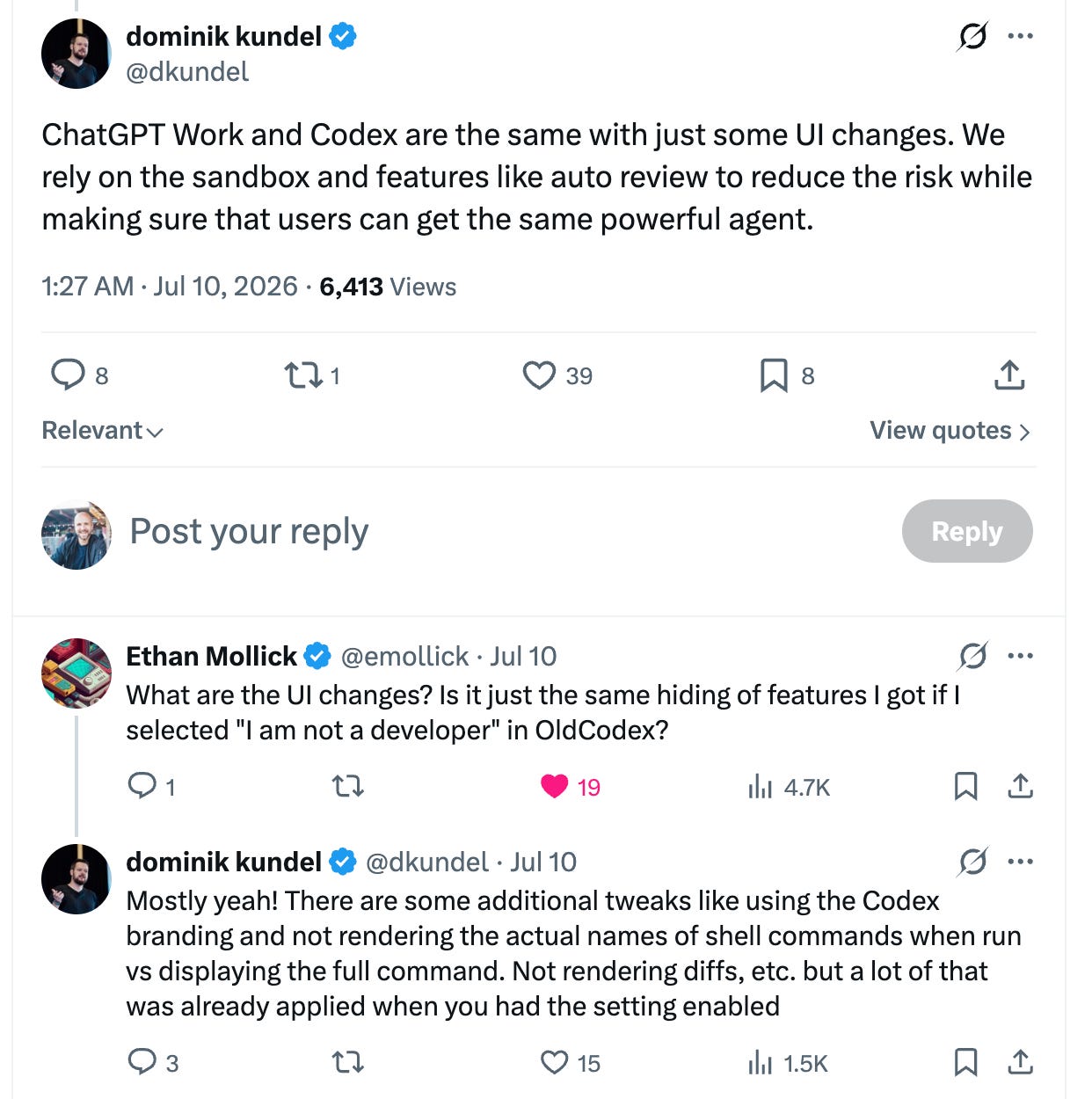
What he’s saying in plain language is that the biggest update is about how things look. Which in my view is a good thing. Codex was (is?) incredibly good.
I’ve been running Claude Cowork and ChatGPT Codex in parallel since February, and my experience of the new ChatGPT Work so far is that I haven’t fallen off my chair yet, but I understand the logic in making this more accessible. Codex has been a bit complex, and I think Claude Cowork has gained ground largely because it’s focused on “work”.
The takeaway from all of this?
I’ve said it before and I’ll say it again. Everything points to the coding capability from Claude Code and Codex moving from engineers to everyone who sits in front of a screen all day. We saw it with Cowork (in both the Claude and Copilot versions) and we’re seeing it with Work.
They’re both extremely capable tools, and the organizations I know are working with them see a real upside. Building an agent-like, automated flow in either tool doesn’t take many minutes. What does tend to take time is giving the system the right permissions and having an IT department competent enough to make the right trade-offs.
That’s where the battle this fall will be fought. Who has a forward-leaning IT department that can ensure data integrity while still taking advantage of the tools we’ve now been given. If I generalize, the US is further ahead than Europe here, and I have more Americans who have taken my Cowork for HR course than Europeans.
The models then? I’ve touched on them both. They’re obviously brilliant. Both Fable 5 and ChatGPT 5.6 Sol Ultra are something quite special. I personally prefer Fable 5 as a colleague over 5.6 Sol Ultra when it comes to bouncing things back and forth, but 5.6 Sol Ultra’s ability to take information, compile it and present it... it’s crazy in a good way.
But models aside. They’re good enough for the vast majority of organizations now. It’s not about that anymore. It’s about other things, like what I talk about above regarding competence in the IT department, for example. And competence in HR too, for that matter.
So what should you do now?
Test, obviously! I’ve given this advice to quite a few people this spring. But I’d argue it’s professional negligence not to have either ChatGPT Work or Claude Cowork downloaded. If you’re not allowed to have it on your work computer, buy your own machine, a cheap used one is enough, and run one of them privately there.
Not testing and not understanding what these tools can and can’t do (which is fewer and fewer things) is professional negligence. There are few things we in HR need to understand more than what these tools can do now. Because if you’re good at expressing yourself, think through what your goal is, and give a clear picture of what you want to achieve, these models will give it to you.
The direction from OpenAI, Anthropic and Microsoft (and maybe Google? Hello Google?) is clear. They’re on their way to creating tools that can do pretty much anything that happens in front of a computer. Whether that’s good or bad is up for debate, but to be able to debate it you need to understand what they can and can’t do.
If you need a push to get started, I’m running another round of Cowork for HR. ChatGPT Work will of course be included in it too. The first 10 to sign up also get 30 minutes of individual coaching on setting up ChatGPT Work or Claude Cowork.