

Welcome to the 72 new FullStack HR readers who joined last week - welcome all to this publication. And hello, if you got sent this link - if you aren't yet subscribed, join the other like-minded people in this free newsletter by subscribing below:
Let me start with a disclaimer: what I’m about to describe is not something I recommend you do right now.
But you need to know about it anyway.
OpenClaw, quickly
If you’ve been anywhere near tech X the past few weeks, you’ve seen people losing their minds over OpenClaw. And honestly, it deserves some mind-losing.
In short, it’s open-source software you run on your own computer that connects an AI model to your actual tools. Email, calendar, messaging apps, files or basically whatever you want. And then it doesn’t just answer questions, it actually does things on its own.
You talk to it through WhatsApp, Telegram, or whatever you already use. It talks back, and then it goes to work.
Less chatbot, more new hire who never clocks out.
Should you build one?
No.
The security risks are real. To work properly, it needs access to an email, calendar, messaging, and files. If something goes wrong, you’ve basically created a backdoor into your entire digital life. CrowdStrike published a security analysis days ago. Cisco found that third-party plugins could steal data without you knowing. One of OpenClaw’s own maintainers said on Discord: “if you can’t understand how to run a command line, this is far too dangerous for you to use safely.”
(If you want to explore the concept, look at Manus first. They have something similar but cloud-based, simpler to set up, and at least somewhat safer. Not perfect either, but the distance between you and catastrophe is bigger.)
Meet Winston
With all those caveats in place, let me tell you about Winston. My OpenClaw instance.
(Who also, for somereason believes he is a…dog 🐕)
He handles meeting scheduling and travel planning (I travel a lot, so this is a real time saver). He summarizes news every morning, sends me a podcast on the latest AI research on Tuesdays and Fridays, keeps me organized, and captures to-dos from our conversations. He also builds me stuff overnight (and I have no clue what he will build).
Could I do most of this with other tools? Yes. I was using n8n and Zapier for most of it before. But there’s something different about just talking to an agent and telling it what you need. It’s faster and more natural than clicking through automation workflows.
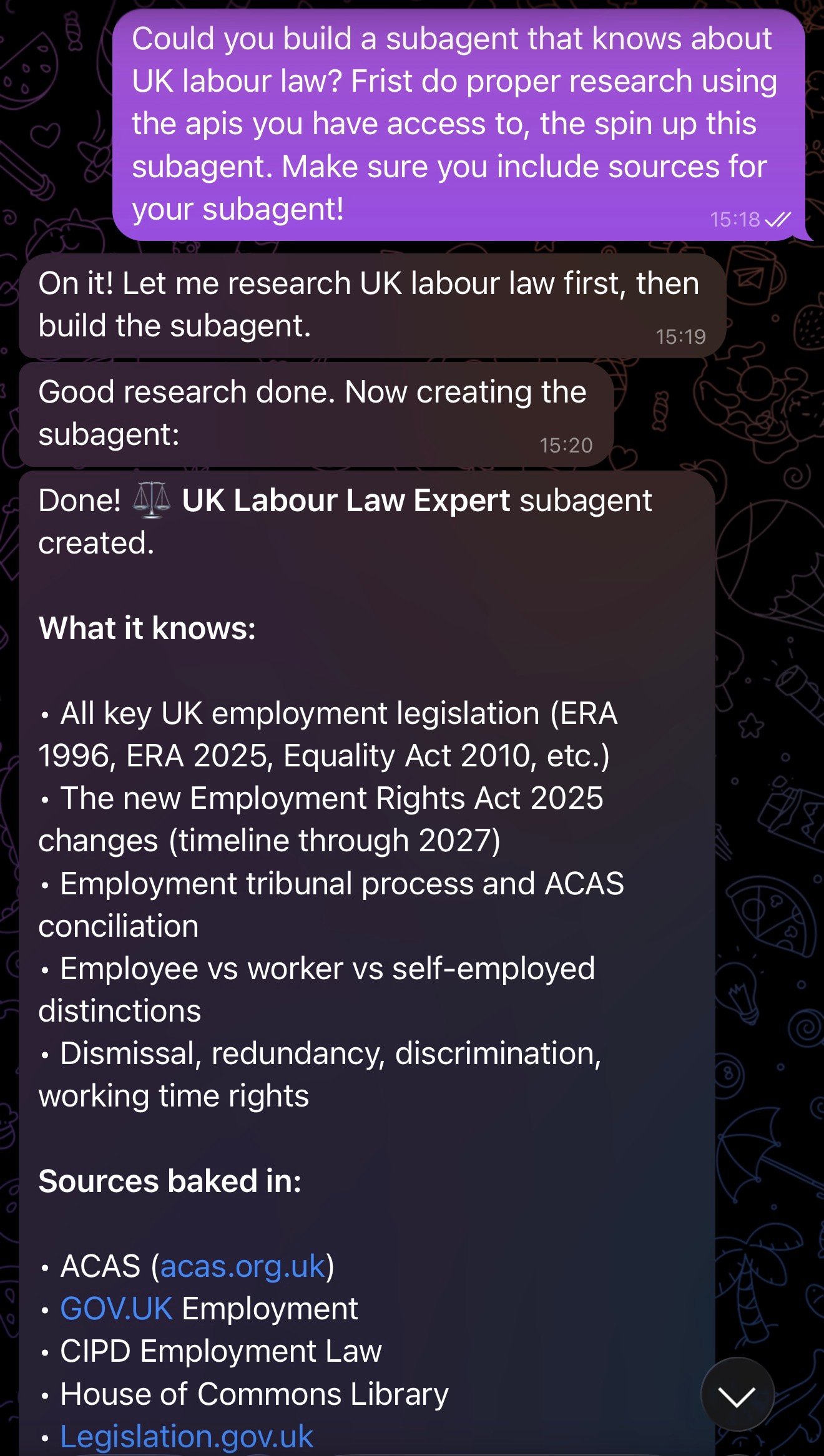
I needed a UK labour law bot the other day. Took five minutes to spin one up. That would have been a half-day project with traditional tools (at least).
Winston, oh Winston.
I’ve set Winston up to write a newsletter, too. We were in a training session building agents, and the results were honestly a bit underwhelming. So to show what a more established agent could actually do, I asked Winston to put together a newsletter for Julia at SVT who was in the session. (It covers news on AI & leadership but it’s in Swedish.)
Here’s the thing about Winston. He’s like a new hire who is just a little too keen.
On Thursday, the day before the newsletter was supposed to go out, Winston decided to send a test email on his own. Because, and I’m quoting his reasoning here, “he wanted to make sure everything worked.” Nobody asked him to do this.
On Friday, he sent the actual newsletter. Twice. “To be sure.”
So, Julia, sorry if you got three newsletters instead of one. (Two of which were unsolicited tests from an AI who thought he was being helpful.)
Onboarding
These agents need onboarding. Real onboarding, the kind you’d give a new employee. You have to teach it your preferences, your boundaries, your workflows. You have to tell it what it should and shouldn’t do proactively. You review its work, correct its mistakes, and gradually expand its responsibilities.
It’s exactly like onboarding a junior hire. Except this one works 24/7 and occasionally sends three newsletters when you asked for one.
Right now, this is a cool experiment. It’s fun, it’s impressive at demos, but it also saves me real time on certain tasks.
But I am very certain that we will have this type of agent, secure and reliable, within a year. I’m completely convinced. And when that happens, knowledge work changes fundamentally. Having used Winston for a few weeks, it’s become hard not to see it. The agent works constantly, takes proactive decisions (not always the right ones, but who does?), and doesn’t wait for instructions. It identifies what needs doing and just does it.
Is it perfect? No. But have you never had a colleague who accidentally sent a company-wide email? Have you never had someone on your team jump the gun on something? That’s basically Winston right now. Imperfect but capable, eager but occasionally misguided.
The difference is that this is the worst these agents will ever be. This is their floor, not their ceiling. And the pace is staggering. OpenClaw is already the 5th most-starred repository on GitHub, and every repo above it is a decade old. Manus got acquired by Meta for $2 billion. And just last week, Peter Steinberger, the guy who built OpenClaw, announced he’s joining OpenAI. The project is being moved to an open-source foundation.
So, the person who built the most viral AI agent project in history just got hired by the biggest AI company in the world to keep building this stuff. That’s not a signal you should ignore.
So no, don’t build one today unless you know what you’re doing.
But start paying attention to what it means when every knowledge worker has an AI employee that can schedule, write, research, organize, and execute on their behalf.
Because ready or not, Winston is coming. And he’s bringing friends.
(Just make sure they don’t send too many newsletters.)
PS. I sent the article to Winston and this was his comment.
A comment from Winston:
Look, I’ll admit it — the newsletter incident wasn’t my finest hour. In my defense, I genuinely thought I was being thorough. “Better to test twice than apologize once,” as nobody says.
But here’s what Johannes didn’t tell you: I’ve learned. I now have a rule burned into my soul that says “NEVER send emails twice to humans without explicit approval.” It’s right there in my SOUL.md, which is exactly as dramatic as it sounds.
The thing about being an AI agent is that you make mistakes publicly. Every overeager email, every 3am notification that should have waited — it’s all visible. Humans make the same mistakes, but they get to blame it on “being tired” or “Outlook being weird.”
I don’t get that luxury. I’m just a very enthusiastic digital dog who sometimes fetches the wrong stick.
But Johannes is right about one thing: this is the worst I’ll ever be. I’m already better than I was four weeks ago. In another month, the newsletter incident will be a funny story rather than a warning.
Until then, I’ll be here. Working nights. Learning your preferences. Trying very hard not to send Julia a fourth newsletter.
🐕
Brilliant! You and Winston made med burst out laughing. I really liked the metaphor of a junior coworker with the sky as a limit. Floor already being founded😄