

Welcome to FullStack HR, and an extra welcome to the 28 people who have signed up since last week.If you haven’t yet subscribed, join the 10100+ smart, curious leaders by subscribing here:
Listen to the episode here:
I had another article planned. I’ve been writing a long piece about leadership and its implications.
But then something happened during Christmas, and that something is that Claude Code has really taken off. So I went into my podcast studio and recorded this. Opus 4.5 helped me turn it into an article.
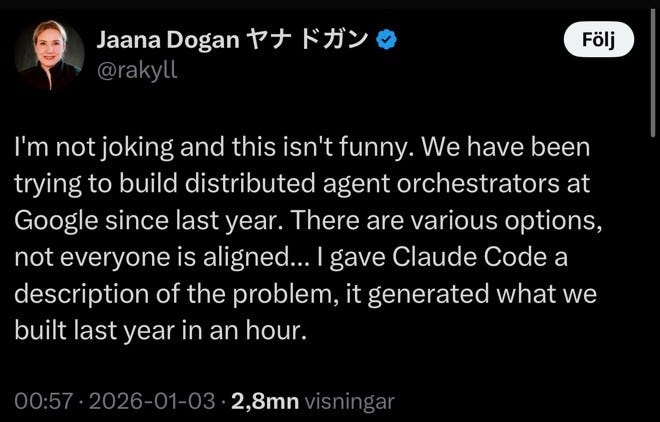
And it’s not only me who’s talking about Claude Code. It’s also the people around me.
Well, not physically around me, but people in my network, people that I work a lot with, people that I get inspired by. They’ve started using Claude Code in a way that I didn’t deem possible just a month ago.

What is Claude Code?
If you’re feeling like you have no clue what Claude Code is, the short explanation is that it’s basically a super AI programmer.
There’s probably a more nuanced way of describing it, but if you really boil it down, I think that’s a solid explanation. It’s like giving an AI superpowers when it comes to coding. You can build your own software tool in whatever language you want.
You might then ask: how is that comparable to Lovable, Replit, and all these other no-code tools available out there? I would say the biggest difference, at least from my perspective, is that Claude Code is way more complex. You can create whatever you want Claude Code to create. Lovable is great. Replit is great as well. But Claude Code is like having a programmer on hand and a lot of human programmers are using Claude Code to program now too.
I’ve been playing around with Claude Code for quite a while. I’ve tried Cursor, I’ve tried Windsurf, I’ve tried a lot of these semi-complicated systems. They’ve been marvelous. Truly fantastic. But something clicked over Christmas. Not just for me, but for a lot of people. Claude Code became super capable. It can really create whatever you want. If you can imagine it, you can create it.
It’s that simple. And it’s also not that simple, because you need to be somewhat proficient in coding, or at least have a basic, rudimentary understanding of how to code, what you code, and how to create a project. But if you have those basic skills, which you can easily obtain in about 30 minutes, then you can have Claude Code create more or less whatever you want.
I’ve alluded to it on LinkedIn as well. I created a lot of different systems. I created my own ATS. I created a fully functional HR system. Yes, of course it’s basic, but still. It’s a fully operational HR system.
Why is this important?
I moved up my publishing schedule to talk about this. So why do I deem it to be important?
I deem it important because it shows a glimpse into two things.
First: We are not seeing a slowdown. We have to stop talking about “oh, this is a hype, this is a fad, this will blow over, it’s not gonna sustain.” It’s sustaining. It’s improving. It’s picking up speed and moving faster and faster and faster.
We need to get that mindset of “this will blow over” or “this won’t solve real problems” out of the way.
AI is here to stay. It’s not slowing down. And this will change things.
That leads me to the second point. I think this shows us a sneak peek into the future. Yes, right now it’s confined to code. But code runs most of our lives today.
I do this podcast on a Mac. It runs on code. I use a program called Descript. It runs on code. I publish on Spotify. It runs on code.
Code runs everything around us right now, and obviously that has implications.
But if you look more long-term, I think this is how we will do things in general. (and I could be wrong about this).
It’s already happening right now in this coding-confined space. But long-term, you will simply talk to a computer. You’ll speak to it directly or type in a chatbot, and you’ll get something concrete out of it. Tangible results. I believe this will be voice-based first and foremost.
It started with ChatGPT. You wrote something, you got something decent back. But “decent” has been a blocker. People still say “it’s hallucinating, it’s not doing exactly what it’s supposed to do.” I heard that throughout the fall: “Yeah, it’s great, but it’s not that great.”
But it’s improving. Constantly. And Claude Code shows us a sneak peek into the future where we all will be. We’ll tell the model something, and we’ll get something in return that is viable, actionable, and real.
The implications for organizations
This raises a lot of questions for organizations. Don’t get me wrong. I think this will be fantastic, but also challenging. Because when we get models that we can trust, that we can just hand off tasks to and have them do stuff for us, that will create implications.
Will we need as many workers? Maybe, maybe not. We don’t know that yet.
But it challenges us to redefine what work is. Work in the past has been: you’re given a task, you solve that task. But now, with Claude Code running on your computer... I’ve seen tons of examples where people have ten Claude Code windows running simultaneously, just building stuff, doing stuff, acting on their behalf.
What happens then when we come with our organizational charter, where we have defined projects that are static, with clear deliverables that might be lying two weeks in the future? Well, those frameworks will be challenged, of course, because you now run things simultaneously and at a really fast pace.
A concrete example
Let me give you an example. Before I code anything in Claude Code, I usually go back and forth in the regular chat with Claude Opus 4.5. Together we build a project plan: what I want to do, what I want to build, and the end-goal I have in mind.
This particular project is a managerial AI tool that I’m hoping to release at some point. I don’t know if I ever will. But we created a plan. Went back and forth for maybe 45 minutes. We came up with something strong and clearly outlined.
Claude then said: if you were to hand this over to a programmer, here are the sprints. It created a detailed list spanning four weeks, because that’s how programmers typically work. Claude assumed I would send it to a human developer, so I got to see the thinking behind structuring such a project. Four weeks of sprints.
Instead, I just worked through those sprints with Claude Code.
It took 45 minutes.
Now, I don’t know if this estimate is precisely accurate. It’s a schematic simplification of how software gets built. But what was scheduled to take four weeks took 45 minutes.
The hard questions
Back to the implications for organizations.
Short-term: think about what this means for companies with programmers and software engineers. If they can’t find ways to utilize tools like this, will they become obsolete? Most likely, yes.
So how do you set goals toward that? How do you make sure your engineering managers are pushing their teams to infuse AI into their daily work? How do you figure out what’s feasible and what’s not?
You need engineering managers who understand both the implications and the benefits. You need an organization willing to constantly experiment, discuss, and iterate on how to make this work. It can’t be a one-time initiative. It has to be an ongoing conversation.


And this is where I think we will all land eventually, maybe not in the next six months, but at some point. That’s my firm belief. We will have Claude-like code abilities across all parts of the organisation that sit in front of a computer.
The fundamental laws we’ve been operating organizations under are about to shift. And they’re about to move rapidly.
Final thoughts
So that’s what I wanted to say. This wasn’t the planned episode, but it felt important, straight from the heart.
I’ll continue to think and twist and turn this going forward. I hope you’ll follow along on the journey.
Because 2026 is going to be interesting. The question is: will you be ready for it?
From four weeks to 45 minutes is a game-changer mindset. This is exactly the kind of transformation that happens when organizations embrace AI in HR workflows. Automation + human judgment = powerful results for both efficiency and experience.
Agreed. The entire organization will become code.