

Welcome to FullStack HR, and a special welcome to the 24 people who signed up since last week.
If you haven’t yet subscribed, join the 11700+ smart, curious HR folks by subscribing here:
🎧 → Spotify
🎧 → Apple Podcast
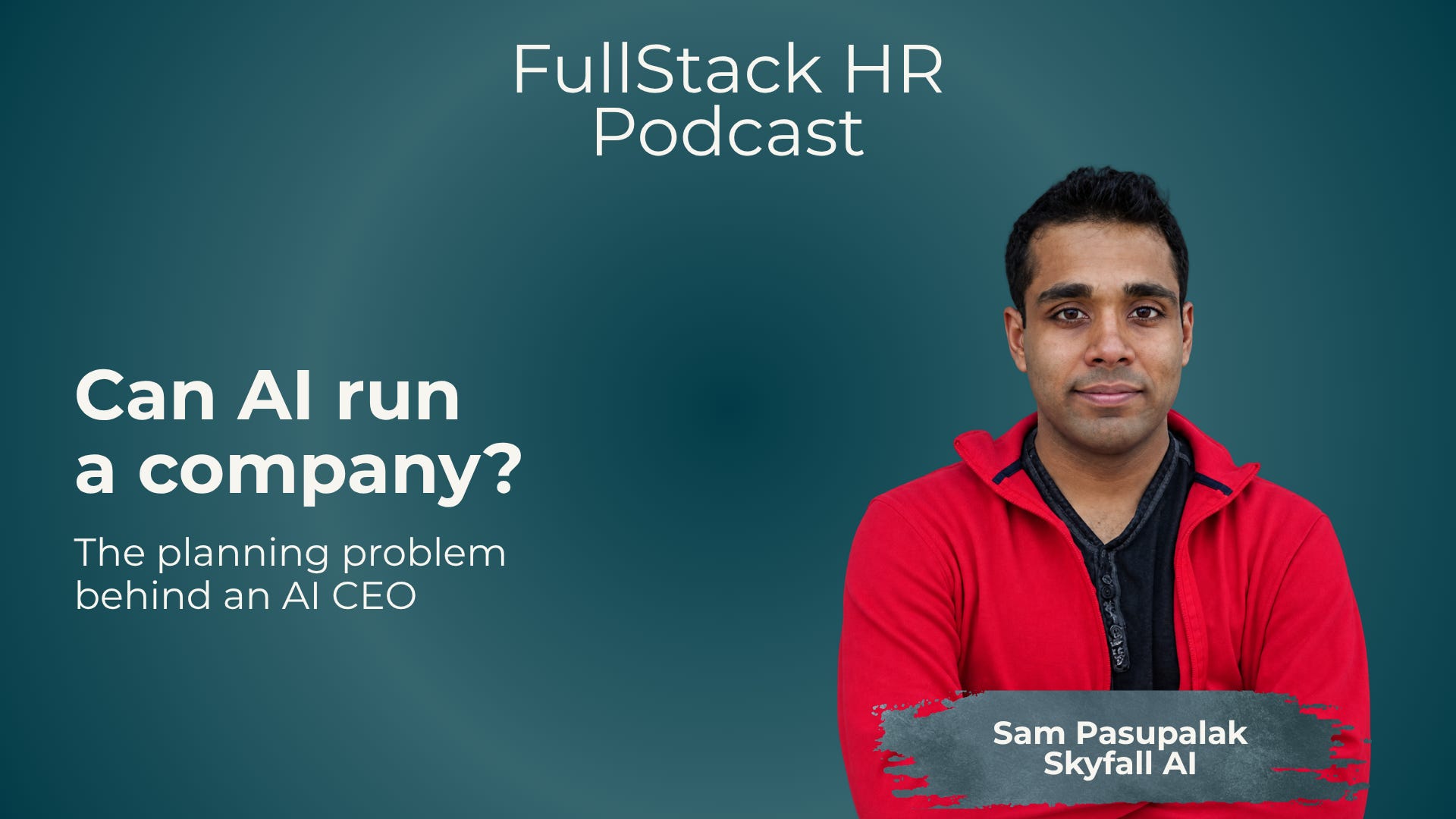
Today, I have Sam Pasupalak on the podcast. It’s a short but sweet one (and a highly interesting one, if I might say so myself)
Sam is the co-founder and CEO of Skyfall AI, where his team is working on an AI CEO. In this episode of FullStack HR, we discuss what that would mean and how he separates the operational work from the human relationships involved in leading a company.
The team is still working on the research behind that ambition. Sam explains where he expects progress first and which problems he thinks will take longer.
Here’s some of what we get into:
Deciding what to work on. Sam sees today’s AI tools as useful for execution once a task is defined. He explains why planning across teams and over longer periods is central to what Skyfall AI is trying to build.
Anticipating the consequences of a decision. We discuss world models, which Sam describes as a way to imagine possible futures before acting. His team wants to apply that approach to businesses, where conditions keep changing.
Learning while the business changes. People absorb new information, remember what matters, and forget what no longer helps. Sam explains why building that capacity into an AI system remains an open research problem.
The work he believes stays human. Even with his ambition to automate operational decisions, Sam sees relationships with employees and their motivation as human responsibilities. We discuss what that could mean for managers and CEOs.
Where automation might arrive first. Sam describes small online SaaS and direct-to-consumer businesses as early candidates. He also says Skyfall AI has acquired businesses to pursue that work, with results still to be announced at the time of our conversation.
Listen to the full conversation with Sam Pasupalak from Skyfall AI on FullStack HR.
Starting with small SaaS and direct-to-consumer businesses fits what separates automation that pays off from automation that stalls: high-volume work, checkable output, mistakes that can be undone. Long-horizon planning across teams has none of those properties, so it's where a world model (software that simulates outcomes before acting) gets its hardest test.
The line Sam draws around relationships and motivation may also be where accountability sits. Ford rehired 350 quality inspectors after its 900-camera AI inspection system missed defects that needed experienced judgment. Camunda's survey of 1,000 process leaders found 72 percent had seen AI projects fail because of process gaps. When an AI-made plan goes wrong in a business with employees, who signs for it?